Why Version Control Exists and Why Developers Need It ?

A real-life example to understand Git and version control
Description
Before version control systems existed, developers had no proper way to manage code changes.
They shared projects using pendrives, emails, and local folders, which worked only for very small tasks.
As projects and teams grew, this approach started failing badly.
This blog explains why version control exists, using a simple real-life analogy and then connects it to how modern Version Control Systems (VCS) work today.
Life Before Version Control System :

Before version control systems existed, developers managed code manually.
A developer would write code on their computer and share it with others using:
Pendrives
Email attachments
ZIP files
After getting feedback, the code was changed and shared again in the same way.
At first, this looked simple.
But when changes increased, problems started.
To avoid losing work, developers created folders like:
final
final_v2
latest_final
Soon, even the developer could not answer:
Which version is the latest?
What changed last time?
Who made those changes?
When multiple people worked on the same code:
Files overwrote each other
Changes were lost
There was no history of edits
Pendrives also had risks:
They could be lost
They could get corrupted
They worked only for one person at a time
This made collaboration slow, confusing, and unsafe.
This entire situation is known as the Pendrive Problem.
It clearly showed that manual code sharing does not work, especially for teams.
This is why developers needed a better solution - Version Control Systems.
Introduction to Version Control Systems :

A Version Control System (VCS) is a tool that helps developers track and manage changes to code.
A VCS allows developers to:
Record every update to the codebase
Collaborate without overwriting each other’s work
Go back to earlier versions if needed
Maintain a clear history of changes
Instead of pendrives, developers work using a repository.
How Version Control Works (Simple View) :

Instead of sharing code using pendrives or WhatsApp, developers use a repository to work together.
The repository is a central place where the main project code is stored.
Every developer has their own working copy on their computer.
Developers make changes in their working copy without affecting others.
When a change is ready, they commit it to the repository.
Other developers update their working copy to get the latest changes.
This way, everyone stays in sync and works on the same project safely.
In short :
\> Repository = main storage
\> Working copy = personal workspace
\> Commit = send changes
\> Update = receive changes
This system makes teamwork organized, safe, and efficient.
Why Version Control Became Mandatory in Modern Development
As software projects became bigger and more complex, developers needed a better solution.
Version Control Systems were created to:
Track every change made to the code
Prevent data loss
Maintain complete history
Allow multiple developers to work together safely
Instead of sharing files manually, developers started working on a shared repository.
This made collaboration faster, safer, and more reliable.
Today, version control is not optional.
It is a mandatory part of modern software development.
Popular Version Control Systems :
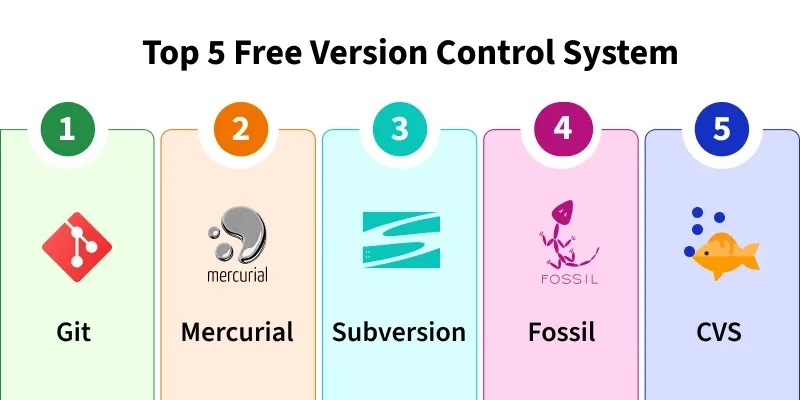
Git is the most widely used Distributed Version Control System, developed by Linus Torvalds in 2005 for managing the Linux kernel. It is highly efficient, supports branching and merging, and has a fast, decentralized workflow. Git is the backbone of services like GitHub, GitLab and Bitbucket, making it a popular choice for developers worldwide.


